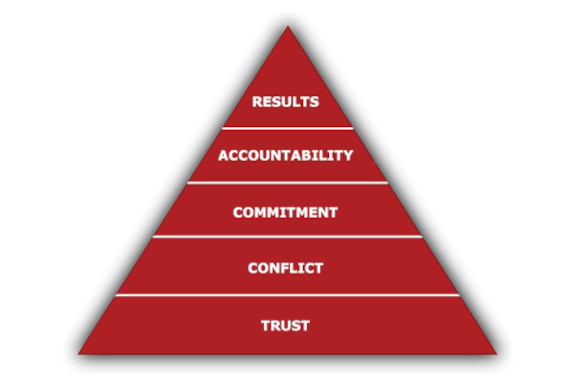
Patrick Lencioni, a thought-leader on effective teamwork and collaboration, introduced his powerful and approachable model The Five Dysfunctions of A Team, over 20 years ago. Wiley then leveraged its expertise in training program development to bring Lencioni’s model to life through engaging and personalized learning experiences that includes DISC.
1-The Five Behaviors Personal Development Assessment
The Five Behaviors Personal Development Assessment and was created to harness the power of The Five Dysfunctions of a team, across the entire organization.
The Five Behaviors Personal Development Assessment was designed specifically to work for individuals; participants do not all need to be part of the same team. Rather, individuals can carry the takeaways from one team to the next, enabling a culture of teamwork.
This solution teaches individuals to become better teammates by integrating the model from Lencioni’s book, The Five Dysfunctions of a Team, at the organizational level.
The assessment assesses an individual’s approach to teamwork, provides personalized insights on how they can more effectively work with others, and teaches participants the critical behaviors and interpersonal skills needed to work together effectively.
The result is a unique and impactful solution that empowers individuals to rethink their approach to teamwork, shape new, more productive behaviors to increase productivity, and create a common language that completely redefines what it means to work together to build a culture of teamwork.
2-The Five Behaviors Team Development Assessment
Based on the work of Patrick Lencioni’s international best-seller The Five Dysfunctions of a Team, The Five Behaviors® Powered by Everything DiSC® helps teams apply The Five Behaviors® model of Trust, Conflict, Commitment, Accountability, and Results to drive team effectiveness and productivity.
The program uses Everything DiSC, a tool that helps build effective team communication and relationships, to help participants understand their individual DiSC® style and discover how each style brings value to the team.
What is the difference between both versions of the assessment?
The Five Behaviors Team Development Program, develops a cohesive intact team. It is offered in English.
The Five Behaviors Personal Development was designed specifically to work for individuals; participants do not all need to be part of the same team. Rather, participants can carry the takeaways from one team to the next, enabling a culture of collaboration and teamwork. It is offered in both French and English.
In summary
The Five Behaviors – Team Development
- Specific dysfunction within a team
- Creates a team credo
- Empowers a single team
The Five Behaviors – Personal Development
- Individual impact on the team
- Scales across the organization
- Fosters a collaborative organizational team culture
Both Assessments use the Model of the Five Dysfunctions of A Team
Both solutions use the framework of best-selling author Patrick Lencioni’s model for teamwork which focuses on Trust, Conflict, Commitment, Accountability, and Results. This framework is combined with personalized insights to create powerful, customized, and authentic team development solutions that empowers both teams and individuals to make lasting change.
View a sample of the Five Behaviors Personal Development Profile
View a sample of the Five Behaviors Team Development Profile
Team Development Assessments are complementary to a team workshop. How does it work when purchasing a personal development assessment if no team workshop or conference is planned?
1-Take the assessment online
2-Receive a personalized report
3-Bring the learnings to life with a personalized debrief session
Includes
- One Assessment with online administration
- One Report
- One 1 hour Facilitator-Led Virtual Debrief Session
OTHER REPORTS AVAILABLE:
Progress Report
The Five Behaviors® Progress Report highlights areas of greatest improvement and decline, offers productive points of discussion, and provides an action plan to help teams prioritize and set specific goals. You'll be able to compare how a team’s performance has changed over time and highlights areas of greatest improvement and of greatest decline.
The Progress Report also includes:
- Your Team’s Survey Results
- Points of Discussion
- Action Plan
- Identify the team’s priorities for improvements
- Set specific goals
- Appendix
- The Impact of Your DiSC® Style
- Everything DiSC® Team Map
- Conflict Team Map
Why should I use this tool? How will it help my team?
“Teamwork ultimately comes down to practicing a small set of principles over a long period of time.” —Patrick Lencioni The Five Behaviors program is a framework that helps team members have deeper conversations about how they work together on a day-to-day basis. It’s a program that is rich enough for a team to come back to again and again. The Progress Report is designed especially to show a team how its behaviors have changed as compared to the last time the team was assessed. In addition to showing the improvements on the team, the report outlines challenges that may be hindering further development.
When do I use the Progress Report versus starting over?
Periodically check your team’s progress using The Five Behaviors Progress Report. Although, if a team has a new leader, we recommend they re-take the original Five Behaviors assessment. Additionally, if more than 40% of the team has changed since the original assessment was administered, we recommend re-administering the assessment and having the team create new action plans for improvement.
Does each team member receive an individual report?
Yes, each team member will receive a personalized report. This report includes the person’s DiSC style and narrative from the original report in addition to outlining the team’s progress. It also includes the updated DiSC Team Map and Conflict Team Map.
Comparison Report
The Five Behaviors Comparison Reports are follow-up reports that can be created for any two participants to illustrate their similarities and differences. Based on data from the personality items in The Five Behaviors assessment, the reports are organized around The Five Behaviors model and illustrate two continua per behavior. The research-validated comparison reports can be used to continue to instill The Five Behaviors model and language and to emphasize the importance of the behaviors for both individual relationships and team functioning.
Why use Comparison Reports with a team product?
The Five Behaviors® program is designed to help teams become more efficient and effective. But, of course, teams are made up of individuals, so one-on-one relationships can have a big impact on a team as a whole. Comparison Reports are a great tool to use to help team members learn more about one another and improve their individual relationships and, by extension, their ability to work together. Whether introducing new teammates, helping to build rapport, or working to resolve an interpersonal conflict, Comparison Reports can be a great addition to a Five Behaviors program.
How can I use the Comparison Reports?
There are a number of ways to incorporate Comparison Reports into your programs, depending on the team and its needs:
- During a workshop: At the end of each module, assign pairs and give participants the page from the Comparison Report that corresponds to that module’s behavior. Allow time for the pairs to work through the page. This will both deepen their understanding of the behavior and help to build interpersonal relationships. You could elect to use the same pairs for each module or switch them up each time. EPIC will allow you to print Comparison Reports for all possible team member combinations.
- In between sessions: If you’re facilitating The Five Behaviors over multiple sessions, you could use the Comparison Report as homework. Assign pairs, have the participants meet in between sessions to discuss their Comparison Reports, and ask them to prepare to share their findings and experience during the next session.
- For new team member(s): To help a new team member get acclimated more quickly, have that person go through a Comparison Report with each team member one-on-one. The new team member will get a chance to learn more about his or her new colleagues and how they might best work together while also being exposed to The Five Behaviors model and language.
- In conflict situations: If the conflict between two team members is affecting the team, the Comparison Report can be used to help them examine why they may be having difficulty working together and explore ways in which they might resolve their issue(s). Depending on the nature/severity of the conflict, the two members could work one-on-one, or you could facilitate the conversation.
- As a follow-up/reminder: Comparison Reports can be used as part of team meetings (for example, team members could meet in pairs for 10 minutes during the meeting to review their reports) or as part of a more formal follow-up to a Five Behaviors program. In either case, the report can be used to continue to instill The Five Behaviors model and language and to emphasize the importance of the behaviors for both individual relationships and team functioning.
View a sample Comparison Report
The Team Building Agency offers activities based on your needs and that are tailored for your team! Do not hesitate to share with us what you would like to accomplish as a team.
CONTACT US NOW TO OPTIMIZE YOUR TEAM'S POTENTIAL!